You’re searching for DMCA ignored hosting because something on your site got taken down — or you’re building a project you know will attract takedown notices. Maybe it’s a forum, a streaming aggregator, an adult site, a leak archive, or a piece of journalism that powerful interests would rather see disappear. Whatever it is, you’ve hit the limit of what mainstream hosts will tolerate.
This guide explains exactly what DMCA ignored hosting is, how it actually works under international law, which jurisdictions enforce it, what it costs, and how to choose a provider that won’t fold under the first lawyer’s letter. By the end you’ll know whether DMCA ignored hosting fits your use case — and what to look for if it does.
The 30-second version
DMCA ignored hosting means your server lives in a country that isn’t bound by the US Digital Millennium Copyright Act. When a US-based DMCA takedown notice arrives, the host has no legal obligation to act on it — so they don’t. Your content stays online. This isn’t illegal: it’s how international jurisdiction works. The host is following their country’s laws, not the US’s.
What is DMCA ignored hosting, exactly?
DMCA ignored hosting is web hosting provided from a jurisdiction outside US legal reach, by a provider that publicly refuses to act on Digital Millennium Copyright Act (DMCA) takedown notices. The technical infrastructure is identical to regular hosting — Linux servers, cPanel or DirectAdmin panels, the same software stack — but the legal posture is fundamentally different.
The phrase “DMCA ignored” is slightly misleading. The host isn’t ignoring a law that applies to them; the law simply doesn’t apply. The DMCA is United States legislation. A server in the Netherlands, Iceland, or Switzerland is governed by Dutch, Icelandic, or Swiss copyright law respectively. Those laws have their own takedown procedures — much narrower in scope, with stricter evidence requirements, and crucially, no automatic obligation to remove content within a 24-48 hour window.
Most US-based hosts (AWS, Google Cloud, GoDaddy, Bluehost, SiteGround) are required by the DMCA’s safe harbor provisions to remove allegedly infringing content quickly when notified, or risk losing their own liability protection. They do this aggressively — automated systems often suspend entire accounts on a single complaint, with no human review. The DMCA itself was designed this way: shift the legal risk from large platforms onto smaller actors who have to fight to restore content.
Offshore hosts operate under no such pressure. They evaluate complaints under their local law, which usually means: provide a court order from our jurisdiction, or we don’t act.
How a DMCA takedown actually works (and where it stops)
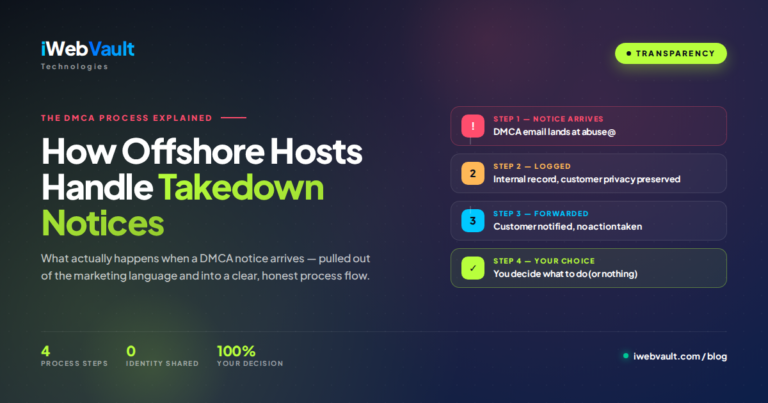
To understand what “ignored” really means, you need to understand the takedown flow. Here’s what happens when a rights holder spots allegedly infringing content on your site:
Step 1 — Discovery
A rights holder (a record label, film studio, image agency like Getty, a publisher, etc.) discovers content they claim infringes their copyright. Usually this is found by automated scrapers, not humans.
Step 2 — Notice sent to host
Their lawyer (or more often, a DMCA-as-a-service firm) sends a takedown notice to the WHOIS abuse contact for the IP address. The notice asserts ownership, identifies the content, and demands removal.
Step 3a — US-based host responds
If the host is US-based, they’re legally required to remove the content quickly to maintain safe harbor protection. Many just suspend the entire account. The site owner can file a counter-notice, but during the 10-14 day waiting period the content is gone — and by then the news cycle has moved on.
Step 3b — DMCA ignored host responds (or doesn’t)
A host in a jurisdiction without DMCA equivalents either replies with a polite explanation that they don’t process foreign takedowns, or doesn’t reply at all. The content stays online. To force removal, the rights holder would need to obtain a court order in the host’s country — expensive, slow, and rarely worth the effort.
This is why DMCA ignored hosting isn’t “lawless” or “above the law.” It’s just outside a specific country’s law. If your content is genuinely illegal under your host’s local jurisdiction — child exploitation material, terrorism content, fraud — a DMCA-ignored host will absolutely act, and quickly. The “ignored” applies only to civil copyright claims under foreign legislation.
Which countries host DMCA-ignored servers?
Not all “offshore” is created equal. Some jurisdictions market themselves as DMCA-ignored but quietly cave under industry pressure. Others have actively defended hosting providers in court. Here’s what each major option looks like:
🇳🇱 Netherlands
The default for European offshore hosting. Strong privacy laws, no automatic takedown obligation, mature data center infrastructure, excellent connectivity. Most “DMCA ignored” hosts route through Amsterdam (AMS-IX) or Rotterdam. Caveat: Dutch courts will issue removal orders for clearly illegal content if a Dutch lawyer pursues it.
🇮🇸 Iceland
Famously friendly to journalism, leaks, and free expression — partly thanks to the Icelandic Modern Media Initiative pushed by WikiLeaks-era activists. Limited but high-quality capacity. Higher prices due to remote location and limited fiber options.
🇨🇭 Switzerland
The strongest privacy posture in Europe. Swiss law treats data as effectively private property. Excellent for sites where the operator’s anonymity matters as much as the content’s survival. Premium pricing reflects this.
🇧🇬 Bulgaria
Cheaper than Western Europe with reasonable connectivity. Looser copyright enforcement than Germany or France. Less reputable than Netherlands but workable for cost-sensitive projects.
🇷🇴 Romania
Similar profile to Bulgaria. Some long-standing offshore hosts (since the early 2000s) operate from Bucharest. Generally good DDoS protection due to historical demand from the sector.
🇲🇩 Moldova
The most permissive of the European options. Useful for projects that would attract scrutiny even in the Netherlands. Lower-grade infrastructure and connectivity, so reserve this for niche needs rather than mainstream traffic.
iWebVault’s perspective: our infrastructure is split across Dutch and Bulgarian data centers, chosen specifically because they offer the best balance of legal protection, infrastructure quality, and price. We deliberately don’t host in Moldova or other extreme-permissive jurisdictions — the reputation cost outweighs the marginal legal benefit for our customer base.
Is DMCA ignored hosting legal? (yes, with limits)
Yes, DMCA ignored hosting is legal. The legality applies in three layers:
- The host’s operation is legal in their jurisdiction. A Dutch hosting company operating under Dutch law isn’t violating anything by not enforcing US copyright claims.
- Your use of the service is governed by where you are. If you live in the US and host pirated movies on Dutch servers, you’re personally still violating US copyright law. The host won’t take you down, but US law enforcement can still subpoena you locally.
- Truly illegal content is illegal everywhere. Child sexual abuse material, terrorist incitement, and content used for fraud are illegal in all jurisdictions. No legitimate host — offshore or otherwise — will protect that content.
For the overwhelming majority of legitimate use cases — adult content (in legal markets), forums with user-generated content, leak journalism, controversial commentary, archives of disputed material, fan communities — DMCA ignored hosting operates entirely within both your local law and the host’s local law. The “gray zone” is narrower than the marketing makes it sound.
Who actually uses DMCA ignored hosting?
Investigative journalists & leak sites
Publishing documents that powerful actors want suppressed. Subpoenas, takedown abuse, and SLAPP suits don’t work against offshore infrastructure.
Adult content operators
The largest legitimate use case. Adult content is legal in most jurisdictions but constantly fights DMCA abuse from competitors and bots — offshore hosting eliminates that overhead.
Streaming aggregators & file-sharing platforms
User-generated content sites where the operator can’t realistically vet every upload. DMCA’s “safe harbor” was supposed to protect them, but US hosts increasingly suspend on complaint volume alone.
Forums & community platforms
Politically controversial discussion spaces, banned-elsewhere communities, anonymous boards. Survival means hosting where takedown demands can’t reach.
Gambling & gaming operators
Sites licensed in jurisdictions like Curacao or Malta but blocked by US-aligned hosts. Offshore infrastructure keeps them online for international audiences.
Whistleblowers & activists
Anyone publishing content that powerful private interests or governments would prefer to suppress through legal pressure rather than addressing the underlying claims.
DMCA ignored vs. bulletproof vs. regular hosting
Three terms get used interchangeably in this space and shouldn’t be. Here’s how they actually differ:
| Feature | Regular hosting | DMCA ignored | Bulletproof |
|---|---|---|---|
| Responds to US DMCA | ✓ Within hours | ✗ No | ✗ No |
| Responds to local court orders | ✓ Yes | ✓ Yes | ✗ Often no |
| Allows truly illegal content (CSAM, fraud) | ✗ Never | ✗ Never | ✓ Sometimes |
| Requires KYC / ID at signup | ✓ Usually | ✗ Anonymous | ✗ Anonymous |
| Accepts cryptocurrency | Sometimes | ✓ Yes | ✓ Yes |
| Typical monthly cost | $3–$15 | $4–$50 | $80–$500 |
| Risk of seizure / criminal action | Low | Low | Real |
| Suitable for legitimate business | ✓ Yes | ✓ Yes | ✗ No |
The distinction matters. Bulletproof hosting is a criminal-adjacent category — providers who knowingly host phishing operations, malware command-and-control servers, and other clearly illegal infrastructure. They charge enormous premiums and operate under constant law enforcement pressure. DMCA ignored hosting is a legitimate commercial category serving customers who want protection from civil copyright enforcement, not from criminal liability.
If a host markets itself as accepting “anything goes,” that’s a bulletproof host, not a DMCA ignored host. Avoid them. Your data is more vulnerable on a bulletproof host than on a regular one — they get seized regularly.
What to look for in a DMCA ignored host
Marketing pages all sound similar. These are the things that actually matter when you’re choosing a provider you can trust with your project’s survival.
1. A real published abuse policy
Look for an explicit policy page that names what they will and won’t act on. Vague “we respect privacy” copy is meaningless. A real host publishes their abuse-handling procedure. You can read our DMCA policy as an example.
2. No-log infrastructure
Server logs are the first thing requested in any legal pressure scenario. A serious DMCA ignored host minimizes what they retain — IP connection logs, in particular, should be discarded quickly or never stored. Ask before signing up: “How long do you retain connection logs?” If the answer is more than 7 days, look elsewhere.
3. Anonymous signup that’s actually anonymous
“Anonymous” should mean no government ID, no phone verification, no real-name requirement. A throwaway email address and a cryptocurrency payment should be enough. If they require a phone number or ID upload, the whole offshore premise is compromised — anything they collect can be subpoenaed.
4. Cryptocurrency payment
Bitcoin, Monero, or USDT — accepted at the moment of signup, not “via support ticket on request.” If they only accept credit cards or PayPal, your identity is permanently linked to your hosting account through the payment processor, regardless of what the host claims about anonymity.
5. Owned infrastructure, not resold AWS
Some “offshore” hosts are just resellers of US cloud providers, dressed up with privacy marketing. The moment AWS or DigitalOcean receives a complaint, your offshore host has no way to protect you — they don’t own the servers. Ask: “Do you operate your own hardware?” A serious host will say yes and tell you which data centers.
6. DDoS protection
Controversial sites attract attacks. Make sure your host’s network includes meaningful DDoS mitigation at the edge — not just “we’ll null-route you when attacked.” Our infrastructure includes anycast-routed DDoS protection on every plan, including shared cPanel hosting.
7. Realistic pricing
DMCA ignored hosting costs slightly more than mainstream hosting because of the smaller market and specialized infrastructure. Be suspicious of $1/month “DMCA ignored” offers — those are either misleading (the host folds on first complaint) or oversubscribed to the point of unusable performance. Realistic ranges: shared cPanel from $4–$15/mo, VPS from $40/mo, dedicated from $180/mo.
What does DMCA ignored hosting actually cost?
Pricing varies by what you need and which jurisdiction. As a rough guide for 2026 market rates:
- Shared offshore cPanel hosting: $4–$15/month. Suitable for static sites, small blogs, low-traffic forums. Limited resources but the cheapest entry point.
- Reseller hosting: $15–$80/month. Useful if you’re hosting client sites or running multiple projects under one account.
- Offshore VPS: $40–$200/month. Root access, dedicated resources, real performance. The default choice for anyone running a serious site.
- Dedicated servers: $180–$1,000+/month. Full bare-metal hardware. Required for high-traffic sites, gaming servers, or projects that can’t tolerate noisy neighbors.
- Cloud root reseller: $300–$800/month. Bare-metal performance with managed services and WHMCS included. The choice for serious offshore hosting resellers.
Expect to pay 30–50% more than equivalent US-based hosting for the same hardware tier. The premium covers smaller economies of scale, higher bandwidth costs to non-US regions, and the legal infrastructure that makes the host’s posture defensible.
Common myths about DMCA ignored hosting
“It’s just for piracy.”
No — and treating it that way is what gets you scammed by bulletproof hosts. Adult content, journalism, fan communities, controversial commentary, and small businesses with vindictive competitors all use offshore hosting for legitimate reasons.
“Offshore servers are always slow.”
Outdated. Western European data centers like AMS-IX are among the fastest hubs in the world. A site hosted in Amsterdam typically loads faster for European, Asian, and African visitors than one hosted in Virginia.
“Anonymous hosting means I can do anything.”
No reputable host will protect content that’s illegal under their local law. Anonymous signup protects you from civil harassment, business competitors, and frivolous DMCA abuse — not from criminal prosecution for serious offenses.
“Google won’t index DMCA ignored sites.”
Google indexes whatever the search algorithm finds and considers relevant. Hosting jurisdiction has zero impact on indexability. What gets sites de-indexed is content that violates Google’s own policies — which is a separate issue from where the server lives.
“All offshore hosts are sketchy.”
Some are. Many aren’t. Look for the same signals you’d look for in any hosting provider: clear policies, working support, real infrastructure, transparent pricing, customer testimonials, and reasonable uptime track records. The jurisdiction is a feature, not a red flag.
Frequently asked questions
No. The hosting service itself is legal in the jurisdictions where these providers operate. Your responsibility for what you publish is governed by the laws of your own country — not the host’s. Hosting offshore doesn’t make illegal content legal, but it does shield you from civil takedown abuse and from US-style automated suspension on complaint volume.
Yes, with a reputable provider. At iWebVault, signup requires only an email address and a cryptocurrency payment — no government ID, no phone verification, no real name. We don’t perform KYC because we have no legal obligation to and because collecting that data would compromise the whole premise of anonymous hosting.
No. Google’s ranking algorithm doesn’t penalize sites based on hosting location. What can affect rankings is server speed and uptime — so make sure your offshore host’s infrastructure is genuinely fast (modern data centers, NVMe SSD, LiteSpeed or equivalent web server). All our hosting plans run on LiteSpeed with NVMe storage for exactly this reason.
Reputable DMCA ignored hosts accept cryptocurrency as a primary payment method — Bitcoin, Monero, USDT, and often Ethereum or Litecoin. Some also accept Perfect Money, WebMoney, or other privacy-friendly e-currencies. Avoid hosts that only accept credit cards or PayPal — those payment methods permanently link your identity to your hosting account through the processor, defeating the anonymity premise.
Notices reach offshore hosts constantly — they’re sent by automated systems that don’t check jurisdiction. What changes is the host’s response. A US-based host treats a DMCA notice as a legal obligation. An offshore host treats it as a courtesy communication from a foreign rights holder with no jurisdiction over their operation. The host will typically reply explaining that they don’t process foreign takedowns, and that’s the end of it unless the rights holder pursues local court action — which is rare and expensive.
A VPN hides your traffic as it leaves your computer. Offshore hosting determines where your website lives. They solve different problems and are often used together: you might use a VPN to access your offshore hosting control panel anonymously, then host your actual site offshore so it can’t be taken down by foreign legal pressure. Hosting jurisdiction protects the site; VPN protects the operator.
Theoretically yes, but only by law enforcement of the host’s own country, acting on the host’s own laws — not by US lawyers waving DMCA notices. The threshold for European law enforcement to physically seize server infrastructure is extremely high (typically serious criminal investigations like child safety or organized crime), and legitimate hosts don’t host content that would meet that threshold. The much more common risk is a host going out of business or having a data breach — neither of which is unique to offshore providers.
Depends entirely on where your visitors are. For European, African, Middle Eastern and most Asian audiences, hosting in Amsterdam or Bulgaria is faster than hosting in Virginia or Texas. For audiences concentrated in North America, US hosting will obviously be faster. Many offshore hosts (us included) use anycast routing and content delivery layers to keep performance high regardless of visitor location.
How to get started with DMCA ignored hosting
If you’ve read this far, you have enough context to make a sensible decision. The actual signup process with a reputable provider takes about 5 minutes:
- Choose your hosting tier. Shared cPanel for small sites, VPS for anything serious, dedicated for high-traffic or resource-intensive projects.
- Sign up with a throwaway email. ProtonMail, Tutanota, or a quick disposable address — no real identity needed.
- Pay in cryptocurrency. Bitcoin is universally accepted; Monero is the strongest privacy option if anonymity is critical.
- Receive your credentials. cPanel, DirectAdmin, or root SSH access depending on your plan — typically delivered within minutes of payment confirmation.
- Migrate or build. Upload your existing site, install WordPress, or build from scratch. The hosting infrastructure works the same as any cPanel/DirectAdmin/VPS environment you’ve used before.
Ready to host without takedown anxiety?
iWebVault offers DMCA-ignored cPanel, VPS, and dedicated servers from offshore data centers in the Netherlands and Bulgaria. Anonymous signup. Bitcoin accepted. No log policy. From $4/month.
No ID required · Cryptocurrency accepted · 24/7 support