You want to host a website without leaving a trail. Maybe you’re a journalist protecting sources, a developer who’s tired of giving a credit card to every SaaS, an activist in a country where your name attached to certain content is dangerous, or just someone who believes that paying for server space shouldn’t require handing your full identity to a corporation. Whatever the reason, you’ve decided that anonymous hosting paid for with Bitcoin is the answer.
It can be — but only if you do it right. Half the hosts advertising “Bitcoin accepted” still require a real name at checkout. Half the people who think they’re paying anonymously have already broken their own privacy three steps earlier. And a few key mistakes turn a clean setup into something a determined investigator can unwind in an afternoon.
This guide is the practical version. We’ll cover what genuine anonymity in hosting actually requires, which cryptocurrencies are best for the job (it’s not always Bitcoin), how to acquire crypto without leaving a trail in the first place, and the specific mistakes that quietly compromise people. By the end you’ll know exactly how to set up hosting that’s actually private — not just hosting that says it is.
- The three layers of hosting anonymity — and which most people miss
- Bitcoin vs Monero vs other cryptocurrencies for paying for hosting
- How to acquire Bitcoin without giving up your identity
- The 5 mistakes that quietly compromise your anonymity
- Step-by-step setup with iWebVault, paying in BTC
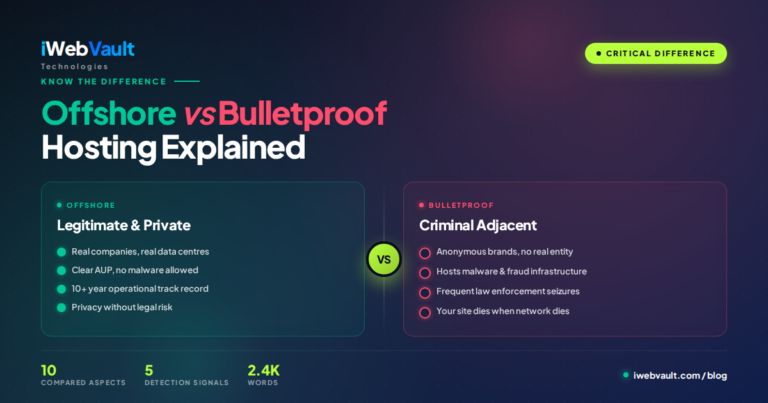
This article assumes you already understand what offshore and DMCA-ignored hosting are. If you don’t, read the pillar guide first.
Why People Actually Pay for Hosting With Bitcoin
Let’s set the record straight. The cliché says “crypto hosting is for criminals.” The reality is that nearly every customer paying for hosting in Bitcoin in 2026 is doing it for one of these reasons:
1. Source protection (journalists, researchers, leak archives)
If you operate a site that lets sources submit sensitive information, the connection between your name and that site is itself a risk to your sources. Anonymous infrastructure isn’t optional — it’s a duty of care.
2. Operating from a sanctioned or restrictive country
Some countries can’t easily access international payment systems through legitimate channels. Others have governments that monitor financial activity to identify dissenters. Bitcoin gives ordinary citizens a way to participate in the global internet without those constraints.
3. Personal privacy preference
Most customers are simply people who don’t want a hosting company to permanently hold their full name, billing address, and card number — data that gets breached, sold, and subpoenaed routinely. Paying in Bitcoin and signing up with a username means no useful identity record exists to leak in the first place.
4. Operational separation from a main business
A consultant who runs a side project, a developer who experiments with controversial ideas, an entrepreneur who wants to test a brand before tying it to their reputation — all have legitimate reasons to keep that activity separated from their main identity. Anonymous hosting with crypto payment is the cleanest way.
5. Resistance to corporate surveillance
Even people with nothing to hide increasingly object to handing personal data to companies that monetise it. Crypto-paid hosting is the most practical opt-out from that pipeline.
Every reputable anonymous host — iWebVault included — bans CSAM, fraud, malware distribution, terrorism content, and direct incitement to violence. Anonymity protects privacy; it doesn’t license harm. Read any provider’s acceptable use policy before assuming “anonymous” means “anything goes.”
What “Anonymous Hosting” Actually Means (The Three Layers)
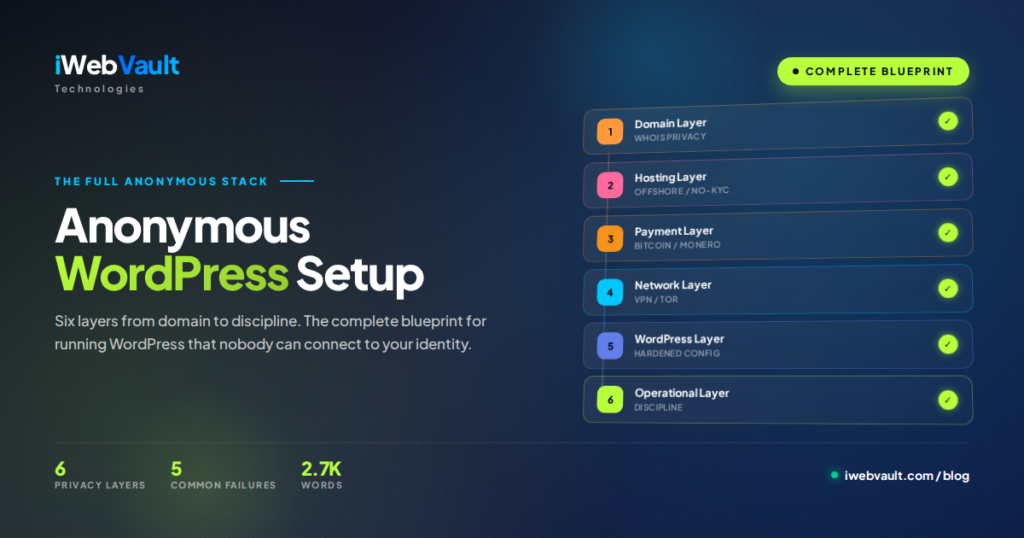
Genuine anonymity in hosting isn’t one switch — it’s three independent layers that all have to hold. Break any single layer and the whole stack collapses. Most failures happen because people focus on the middle layer (payment) and forget the other two.
Layer 1 — Identity at signup
The hosting account itself must not be tied to a real-name attestation. A username, a privacy-respecting email address (Proton, Tutanota, SimpleLogin, etc.), and a strong password are all you should ever have to give. If a host asks for ID verification, address verification, or phone verification, walk away. That data gets stored, breached, or subpoenaed regardless of what their marketing claims.
Layer 2 — Payment
This is the layer most people think about. Bitcoin or another cryptocurrency means there’s no credit card record connecting a financial institution to the hosting account. But — and this is the part that catches people out — crypto is pseudonymous, not anonymous by default. If you acquired the Bitcoin using a KYC exchange and your real name, that trail still exists. We’ll cover how to fix that below.
Layer 3 — Network and operational hygiene
Even with anonymous signup and clean crypto payment, you can still compromise yourself by accessing the account from a personal IP, logging into it from a phone tied to your name, or reusing the same email address you use for your day job. Anonymity is a discipline, not a one-time setup.
Three layers, three independent failures. Account (who signed up), Payment (where the money came from), Access (how you log in). All three have to hold.
Bitcoin vs Monero vs Other Cryptocurrencies for Hosting
“Pay in crypto” is the broad category. Within it, different cryptocurrencies offer very different privacy properties. Here’s how the practical options compare for hosting payment:
| Cryptocurrency | Privacy | Acceptance | Fees | Best for |
|---|---|---|---|---|
| Bitcoin (BTC) | Pseudonymous | Universal | Medium | Default choice; widely accepted |
| Monero (XMR) | Truly private | Limited | Low | Highest privacy requirement |
| Litecoin (LTC) | Pseudonymous | Common | Low | Faster, cheaper than BTC |
| Ethereum (ETH) | Pseudonymous | Common | High | If already in ETH; not ideal |
| USDT / USDC | Tracked | Common | Low | Avoid for anonymous use |
Bitcoin — the right default for most people
Bitcoin is universally accepted, has the deepest liquidity, and the most ways to acquire it without KYC. It’s not fully anonymous — every transaction is on a public ledger forever — but with proper wallet hygiene it’s anonymous enough for the vast majority of legitimate use cases.
Monero — when privacy matters more than convenience
Monero is the only major cryptocurrency that hides sender, receiver, and amount by default. If your threat model is high — investigative journalism, political activism, whistleblowing — Monero is the better tool. The trade-off is acceptance: only some hosting providers take XMR, and you may need to convert through an instant-exchange service.
Stablecoins — usually a bad choice for anonymity
USDT and USDC are issued by centralised companies (Tether and Circle) that comply with US law enforcement requests. They can freeze your wallet. Don’t use them for anonymous payment, even when a host accepts them.
At iWebVault we accept Bitcoin, Monero, Litecoin, and Ethereum. Bitcoin is the default for new customers because it strikes the best balance between privacy and practicality. If you want maximum anonymity, switch to Monero — it’s worth the small extra friction.
How to Pay for Hosting With Bitcoin — Without Breaking Your Anonymity
This is where most people slip. Buying Bitcoin from a major exchange with your real name and immediately sending it to a hosting provider doesn’t give you privacy — it gives you a documented, government-friendly record of exactly what you bought. Here’s the actual procedure:
Step 1 — Use a wallet you control, not an exchange
An exchange account is custodial — the exchange controls the keys and keeps full records. A self-custodial wallet (Sparrow Wallet, Electrum, BlueWallet, or a hardware wallet like Trezor) means only you control the funds, and no third party logs your activity. Set this up before you acquire any Bitcoin.
Step 2 — Acquire Bitcoin without KYC
The cleanest options in 2026 are:
- Bitcoin ATMs with low or no verification limits (varies by jurisdiction)
- Peer-to-peer marketplaces like Bisq, RoboSats, or HodlHodl — no KYC, decentralised order books
- Cash-by-mail services in some jurisdictions
- Earning in Bitcoin directly (some employers and clients pay in BTC)
If you already have Bitcoin in a KYC exchange, you’ll want to put space between that source and the wallet you use to pay for hosting. A trusted CoinJoin service (e.g. via the Whirlpool implementation in Sparrow Wallet) breaks the chain analysis link cleanly. Alternatively, swap your KYC Bitcoin for Monero, then swap back to Bitcoin in a fresh wallet — the Monero leg breaks the trace.
Step 3 — Sign up with a privacy-respecting email
Don’t use your everyday Gmail. Create a fresh address at Proton Mail, Tutanota, or SimpleLogin specifically for this hosting account. Use a unique username that isn’t reused across the internet.
Step 4 — Use a VPN or Tor when signing up and managing
Even if your payment and email are clean, your home IP address logged at signup is identifying. Connect through a reputable VPN (paid with crypto, naturally) or through Tor when creating the account and on subsequent visits.
Step 5 — Send the payment
Place your hosting order, get the Bitcoin payment address from the provider, and send the exact amount from your self-custodial wallet. Avoid sending from an address that’s been linked to your real identity in any prior transaction.
Step 6 — Maintain operational hygiene
Going forward, only access the hosting control panel from your VPN or Tor. Never log in from your personal phone if that phone is tied to your real name and tracks your location. Use a separate browser profile to prevent cross-site tracking from leaking your identity through cookies.
5 Mistakes That Quietly Break Anonymity
Every one of these has happened to real people who thought they had a private setup. Avoid them:
1. Paying from a KYC exchange directly
Sending Bitcoin from Coinbase, Binance, or Kraken straight to a hosting payment address is the same as paying with a credit card from the privacy perspective. The exchange has your full identity, knows the destination address, and will hand both over on request. Always use a self-custodial wallet between the exchange and the payment.
2. Using a personal email “just for signup”
Your everyday email is linked to dozens of services that know your real name. If even one of those services gets breached or compelled to share data, your supposedly anonymous hosting account is connected to your identity. Spin up a fresh address. It’s free.
3. Logging in from a phone
Mobile phones are identity beacons. Carrier records, persistent advertising IDs, and location history mean that “logging in real quick from my phone” leaves a trail comparable to giving the host your driver’s licence. Use a desktop browser through a VPN or Tor.
4. Reusing usernames across the internet
If your hosting username is the same handle you use on Reddit, GitHub, or a gaming platform, anyone who looks up that handle can connect the dots. Generate a fresh username with no prior history. Privacy Guides has good resources on this.
5. Mixing real-name domains with anonymous hosting
You can pay for hosting anonymously, but if your domain is registered with a real-name registrar and visible WHOIS data, the whole setup is compromised. Use an anonymous registrar with free WHOIS privacy — iWebVault offers this alongside our hosting.
Hosting Providers That Genuinely Accept Bitcoin in 2026
Many hosts advertise “Bitcoin accepted” but route the actual payment through Coinbase Commerce or BitPay, both of which require some level of KYC and report large transactions to authorities. The list below covers providers we’ve verified accept Bitcoin directly, without requiring identity verification at any step:
- iWebVault — Bitcoin, Monero, Litecoin, Ethereum, no KYC, automated provisioning
- Shinjiru — Bitcoin, Litecoin, some Ethereum, manual verification on larger plans
- FlokiNET — Bitcoin and Monero, no KYC, technical onboarding
- Orange Website — Bitcoin and Monero, manual processing
- AbeloHost — Bitcoin only, lower-tier plans only without manual review
For the full breakdown of how these compare beyond just crypto acceptance — pricing, jurisdictions, support quality, uptime — see our comparison of the best DMCA-ignored hosting providers.
Step-by-Step: Setting Up iWebVault With Bitcoin
Concrete walkthrough using our own service. The process is similar at other reputable providers:
- Open Tor Browser or connect to your VPN. Don’t visit the iWebVault site from your home IP for the first time if anonymity matters.
- Choose a plan — cPanel for general hosting, VPS for full control. Both work identically for crypto payment.
- Order with username only. Use your fresh privacy-email; pick a username that’s not reused elsewhere; choose a strong unique password.
- Select Bitcoin (or Monero) at checkout. The system generates a fresh payment address for your order.
- Send payment from your self-custodial wallet. Wait for one confirmation — typically 10-15 minutes for Bitcoin.
- Your server provisions automatically. Credentials arrive at your privacy-email. Log in via VPN or Tor going forward.
- Register a domain anonymously if you don’t already have one. Our domain service includes free WHOIS privacy and accepts the same crypto payment methods.
Total time from order to live server is usually under 30 minutes. No phone call, no ID upload, no follow-up “verification” email — if a host needs any of those steps after a crypto payment, they’re not actually offering anonymous hosting.
Frequently Asked Questions
Yes, in nearly every jurisdiction. Hosting content anonymously and paying with cryptocurrency are both legal activities. What matters is whether your content is legal where the server is hosted. If you’re publishing legitimate content, your anonymity is just privacy — which is a legal right, not a workaround.
With iWebVault and other proper anonymous hosts, no. We don’t collect or verify real-name information at any point. The only records we hold are a username, the privacy-email you provided, and the Bitcoin payment address (which is anonymous on our side too — we don’t trace where it came from).
They can suspend the server, but they have no useful identity information to hand over. The most a provider can do under legal pressure is shut down the account — they can’t reveal who owns it because they don’t know. This is the whole point of doing anonymity properly from day one.
Bitcoin is fine for ordinary privacy use cases — keeping hosting separate from your main financial identity, avoiding corporate data leaks, operational separation. Monero is the right choice when your threat model includes a determined investigator (state-level actors, well-funded corporate adversaries, etc.). For 90% of legitimate use cases, properly handled Bitcoin is sufficient.
You can, but it weakens the chain. The VPN company knows your real identity, knows you connect to it, and can be compelled to reveal that. Better: pay for the VPN itself with Bitcoin (Mullvad and IVPN both accept BTC without account-name attestation), or use Tor for an additional layer.
This is the trade-off of full anonymity. We have no out-of-band way to verify you because we never collected your identity. Keep your privacy-email credentials and hosting credentials in a password manager that you control. Without those, the account is unrecoverable — that’s a feature, not a bug.
The same as any other DMCA-ignored hosting. Shared plans from $4-15/month, VPS from $25-80/month. Some providers add a small surcharge to crypto payments to cover volatility — iWebVault doesn’t; you pay the listed price in BTC equivalent at checkout.
Yes. Annual prepayment is the cleanest pattern for anonymity — one transaction, no recurring trail. Most providers including iWebVault offer 10-15% off for annual prepayment in crypto, so you save money too.
Get started with anonymous hosting today
iWebVault accepts Bitcoin, Monero, Litecoin, and Ethereum. Sign up in 5 minutes with a username only, pay with the crypto of your choice, and your server provisions automatically within 30 minutes. No KYC, no real-name attestation, no follow-up questions.
Further Reading
- The Complete Guide to DMCA-Ignored Hosting in 2026 — pillar guide on the legal framework
- Best DMCA-Ignored Hosting Providers Compared (2026) — full comparison across 5 providers
- Privacy Guides — independent recommendations on private tools and practices
- EFF: Anonymity — legal and political framing of online anonymity rights