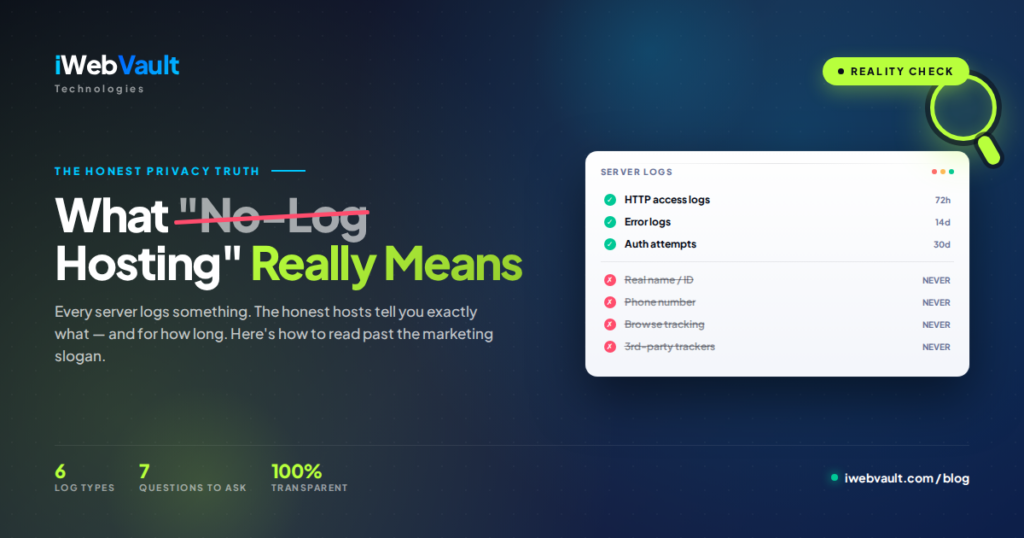
“No-log hosting” sounds clean. Two words. Sounds like the host doesn’t keep records about you — perfect for anyone who values privacy, right? Browse offshore hosting forums and you’ll see the phrase plastered across dozens of marketing pages. What almost none of those pages tell you is that strict no-log hosting in the literal sense doesn’t exist. Every server logs something. The honest question isn’t do they log? — it’s what specifically do they log, for how long, and what could they hand over if pressured?
The gap between “no-log hosting” marketing and what actually happens at the server level is one of the biggest information asymmetries in the privacy hosting industry. Customers who think they’ve signed up for total anonymity discover, sometimes too late, that the host they trusted retained connection logs for 30 days, kept payment records indefinitely, or operated under a jurisdiction that legally requires retention.
This guide pulls the cover off the term. We’ll cover what every server must log to function, the categories where hosts have real discretion, the marketing tricks used to imply more privacy than is actually offered, and the questions you should ask before trusting any “no-log” claim. By the end, you’ll be able to read past the slogan and evaluate a host’s actual privacy posture.
Every web server logs SOMETHING. The genuinely privacy-respecting hosts are transparent about what they log, log only what they need to operate, retain it for the shortest practical time, and never collect identity data they can be compelled to share. That’s the honest version of “no-log hosting” — and it’s what iWebVault actually offers, rather than the impossible promise of zero logging.
What Every Web Server Must Log (Even “No-Log” Ones)
A modern web server cannot function without logging certain things, at least briefly. Anyone claiming “we log absolutely nothing” is either misinformed about their own infrastructure or lying. Here’s what’s technically unavoidable:
Connection logs (temporary, by necessity)
When a visitor hits your site, the web server (Apache, Nginx, LiteSpeed) processes the request through several stages — accepting the TCP connection, routing to the correct virtual host, executing PHP, returning a response. Each stage logs operational data: IP address of the requester, the URL requested, response code, response size, processing time. Without these, the server can’t be debugged, can’t be monitored for attacks, can’t be scaled appropriately.
What honest hosts do: rotate these logs aggressively (typically 24-72 hours), restrict access to operations staff only, and never link them to customer identity.
Error logs (longer retention, by necessity)
When code crashes or a security event occurs, error logs capture what happened so engineers can fix it or respond to incidents. Hosting providers cannot reasonably operate without error logs — they’re how outages get diagnosed and how serious security incidents get investigated.
What honest hosts do: retain error logs for incident response (typically 7-30 days), then rotate. Never share with third parties absent legal compulsion.
Billing and account logs (mandatory)
For tax compliance and dispute resolution, hosts must retain transaction records. This is true even in privacy-friendly jurisdictions like the Netherlands or Switzerland — corporate law everywhere requires some form of financial record-keeping.
What honest hosts do: retain payment-method records but disconnect them from real-name attestation. A Bitcoin payment record is a string of characters; without forced KYC, it doesn’t identify a person.
System logs (mandatory)
The underlying operating system writes logs for kernel events, system service starts/stops, security-related authentication attempts, and backup operations. These are infrastructure-level and aren’t directly customer-related, but they exist.
No host runs zero logs. The differentiator is whether logs are minimal, short-lived, access-restricted, and never tied to identity — versus extensive, long-retained, broadly accessible, and linked to real-name accounts. That’s the actual privacy axis.
What Hosts Actually Have Discretion Over (And What Separates Privacy-First Hosts)
Beyond the unavoidable logging above, providers have significant discretion in five areas. This is where “no-log” claims either deliver real value or become marketing theater.
1. Identity collection at signup
Mainstream hosts demand full name, address, phone number, ID upload for “verification.” Privacy-first hosts ask for a username and a working email address — that’s it. The difference at this stage determines everything downstream: if no identity was ever collected, no identity can ever be logged, leaked, or subpoenaed.
2. Connection log retention
Both extremes exist:
- Privacy-hostile: connection logs retained 90+ days, indexed against customer accounts, queryable by support staff
- Privacy-respecting: connection logs rotated within 24-72 hours, restricted to operations, never indexed against customer accounts
Anything beyond 30 days for ordinary connection logs is excessive for hosting operations.
3. Customer activity tracking
Some hosts log every cPanel/admin panel action a customer takes — file uploads, password changes, plugin installs, database queries through phpMyAdmin. This data has zero operational necessity and exists purely for compliance or surveillance purposes.
4. Payment-to-identity linking
A host that accepts cryptocurrency but requires KYC at the moment of payment has effectively zero privacy advantage over a host that accepts credit cards. Privacy-respecting hosts accept anonymous payment methods without forcing identity verification on the transaction itself.
5. Third-party analytics on the admin panel
You’d be surprised how many “private” hosts run Google Analytics, Facebook Pixel, or Hotjar on their customer dashboard. Every login, every action, every page view is shared with US-based ad-tech companies. iWebVault doesn’t run any third-party trackers on our admin panel — and you can verify this with your browser’s developer tools.
Common Marketing Tricks That Imply More Privacy Than Exists
The privacy hosting industry has developed a vocabulary that sounds reassuring but means less than customers assume. Here are the most common patterns:
“We don’t log customer activity”
Sounds total. Actually narrow — it means they don’t log application-layer admin actions. They might still log every HTTP request, every connection, every system event. The claim is technically accurate while leaving 90% of logging untouched.
“All data is encrypted”
Encryption at rest means the disk is encrypted. It doesn’t mean logs aren’t accessible to the host. The host can decrypt the disk; encryption is a defense against physical theft, not against the host themselves.
“Strict no-log policy”
The word “strict” implies rigor without specifying what the policy actually covers. Read the underlying terms — most “strict no-log” policies still permit retention of connection logs, billing records, and abuse-related data. The “strictness” refers to enforcement, not scope.
“Privacy-first jurisdiction”
Operating from a privacy-friendly country only protects what the host itself doesn’t collect. If the host collects extensive identity data and retains it for years, the jurisdiction doesn’t matter — the data still exists and can be accessed by anyone with administrative access to the company.
“Audited no-log policy”
Most “audits” in the privacy hosting space are commissioned by the host being audited and conducted by friendly firms with limited scope. The famous VPN provider audits set a higher bar — independent firms with full infrastructure access. Almost no hosting providers operate at that audit standard yet.
“We never share customer data”
True under normal operations. The relevant question is what happens under legal compulsion. A host with a subpoena from a competent court will share what they have — they have no choice. The only protection is not collecting the data in the first place.
What iWebVault Actually Logs (Full Transparency)
Here’s our actual logging posture, in concrete detail — because saying “no-log” without specifics isn’t honest:
| Log type | What we keep | Retention | Identity-linked? |
|---|---|---|---|
| HTTP access logs | IP, URL, response code, timestamp | 72 hours rolling | No |
| Error logs (PHP/server) | Error type, file, timestamp | 14 days | By cPanel username only |
| Authentication logs | Login success/failure | 30 days | By cPanel username only |
| cPanel action logs | Major events (terminate, backup) | 90 days | By cPanel username only |
| Billing records | Payment txn hash, amount, plan | Indefinite (legal req) | Only if you provided ID |
| Signup email | Email you used to register | Indefinite | If real email, yes |
Updated January 2026. We reserve the right to extend retention temporarily during active security incidents (e.g. attack mitigation), and we publish notice of this in our status page when it happens.
What this means in practice
A subpoena to iWebVault for “all records about user X” returns:
- Username at signup
- Email address provided (privacy-email if you used one)
- Bitcoin payment transaction hashes (no real-name attestation)
- Possibly login authentication timestamps from the last 30 days
- Possibly error log entries (don’t identify the user)
What it does NOT return: who the person actually is, where they live, what their phone number is, what their other accounts are, what their credit card details are. Because we never asked, we never knew.
The 7 Questions to Ask Before Trusting Any “No-Log” Claim
Use these to evaluate any host claiming privacy-focused operations. Honest hosts will answer them directly; evasive hosts will use marketing language.
1. What specific log files do you maintain on the customer’s infrastructure?
Real answer: HTTP access logs, error logs, authentication logs, by name. Vague answer: “minimal logs as required for operations” — that’s a non-answer.
2. How long is each type of log retained?
Real answer: specific durations per log type. Vague answer: “as long as needed” — meaningless.
3. Are logs linked to customer accounts?
Real answer: clearly yes/no per log type, and on what key (username vs IP vs payment method). Vague answer: “we maintain customer privacy” — irrelevant.
4. What identity data do you collect at signup?
Real answer: a specific list (username, email, payment method). Worrying answer: anything that includes “full name,” “address,” or “ID verification.”
5. What’s your subpoena response process?
Real answer: we respond with the data we have, which is limited to (X, Y, Z). We do not collect (A, B, C). Vague answer: “we respect customer privacy” — that’s not how subpoenas work.
6. Do you publish a transparency report?
Real answer: yes, here’s the URL, here are the numbers from last year. Vague answer: “we don’t track that publicly” — they probably don’t track it at all.
7. What third-party services do you integrate?
Real answer: a specific list (CDN provider, payment processor, monitoring tool). Worrying answer: “we use industry-standard services” — many of which are US-based and themselves required to retain data.
Frequently Asked Questions
Not honestly. Web servers technically cannot operate without some form of logging — even if just for crash recovery and basic operations. Any host claiming “zero logs” is either misinformed about their own infrastructure or being deliberately misleading. The honest version is “minimal logs, short retention, no identity linkage” — that’s what privacy-respecting providers like iWebVault offer.
GDPR Article 30 requires hosting providers to maintain records of processing activities — but those are operational records (what categories of data we process, why, for how long), not customer-identifying records. GDPR actually supports the privacy-first approach by mandating data minimisation. A no-identity-collection model is more GDPR-compliant than an extensive-logging model.
They can request what your host has. With a privacy-first host that operates in offshore jurisdiction and didn’t collect your identity, what’s available to law enforcement is dramatically reduced. The protection isn’t perfect — it’s about minimising the attack surface, not eliminating it. Combine no-log hosting with anonymous registration and crypto payment for the strongest practical protection.
Different threat model. A no-log VPN protects what site you visit; a no-log host protects what site you operate. The technical requirements are also different — VPNs route traffic, so their primary log type is connection metadata. Hosts run applications, so their primary log types are HTTP access logs and error logs. The honest “no-log” claim applies to either, but the specifics differ.
With the records they do keep, plus AUP-based action when needed. iWebVault retains enough operational data (cPanel username, error logs, AUP violation flags) to investigate and act on credible abuse reports, without retaining the identity data that would let us hand a real person to authorities. Privacy and accountability aren’t mutually exclusive.
Yes. Our log volumes are encrypted at rest. But as we noted in the article, encryption-at-rest is a defense against physical theft or unauthorised data center access — it doesn’t protect against the host themselves accessing their own logs. The real protection is minimising what’s logged and how long it’s kept, which we do aggressively.
On a self-hosted VPS where you have root access, you can disable most logging at the OS and web-server level. This is technically possible but operationally unwise — you’ll lose the ability to debug crashes, investigate security incidents, or respond to performance issues. The reasonable middle ground is minimal logging with aggressive rotation, which is what professional privacy-respecting hosts implement by default.
Ask the 7 questions above. Read their detailed AUP and privacy policy. Look for transparency reports. Check independent forums (LowEndTalk, WebHostingTalk, Reddit) for current customer experiences. And test their support’s responsiveness with specific log-related questions before signing up — hosts that can’t answer concretely probably haven’t thought about it concretely.
Hosting with honest privacy, not marketing slogans
iWebVault tells you exactly what we log, for how long, and what’s linked to your account. Minimal logging, short retention, no identity collection at signup — that’s the actual no-log promise that we can keep. Anonymous Bitcoin payment, privacy-respecting email at signup, and a hosting environment that genuinely doesn’t know who you are.
Further Reading
- The Complete Guide to DMCA-Ignored Hosting in 2026
- Anonymous Hosting That Accepts Bitcoin: Complete Guide
- Offshore vs Bulletproof Hosting: Critical Differences
- DMCA Takedown Notices: How Offshore Hosts Respond
- EFF: Privacy issues and surveillance resistance
- GDPR Article 30: Records of processing activities