Most offshore hosting providers will tell you they “ignore DMCA notices.” Almost none of them will tell you what that actually means in practice. Does the notice get forwarded to you? Does the provider log it? Is there a process if the complaint is legitimate? Do they ever take action? Or does “ignored” really mean nothing happens at all?
The opacity isn’t accidental. Some hosts want you to assume “anything goes,” because that’s a stronger marketing message than the legally accurate version. Others stay vague because their internal process changes whenever they get nervous. Either way, you — the customer paying for the service — end up not knowing what to expect when the first notice lands.
This guide pulls back the curtain. We’ll walk through what a DMCA takedown notice actually contains, how a legitimate offshore host handles one when it arrives, what iWebVault does specifically (because we believe transparency builds more trust than vague tough-talk), what you should do as the customer when a forwarded notice shows up in your inbox, and the rare cases where even offshore hosts take action.
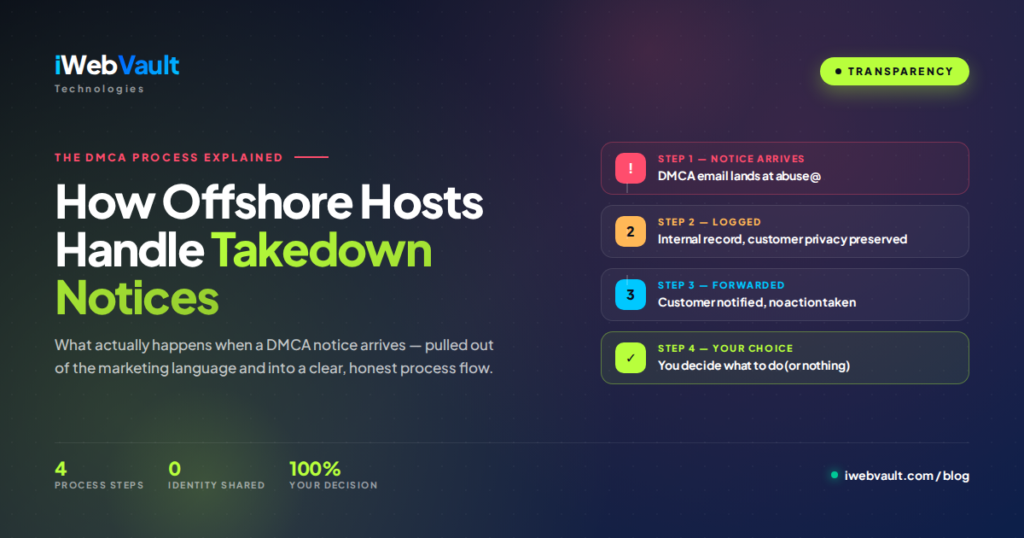
A reputable offshore host forwards the notice to you as a courtesy and takes no further action — the notice has no legal force in their jurisdiction. The decision about whether to act on the underlying complaint is entirely yours. The host doesn’t share your identity, doesn’t remove the content, and doesn’t bill you legal fees for handling the notice. That’s what “DMCA ignored” actually means in practice.
What a DMCA Takedown Notice Actually Looks Like
Before discussing how offshore hosts respond, it helps to know what they’re responding to. A DMCA takedown notice is a formal letter — usually an email these days — that follows a template defined by US copyright law. The standard elements:
The required components
- Identification of the copyrighted work the sender claims to own
- Identification of the allegedly infringing material — specific URLs on your site
- Contact information of the complainant
- A “good faith belief” statement that the use is unauthorized
- A “penalty of perjury” statement that the information is accurate
- A physical or electronic signature of the rights holder or their agent
Where they come from
Roughly three sources, in order of frequency in 2026:
- Automated bots — most notices are generated by bots scanning the web for matches to client-supplied content. Many are false positives.
- “DMCA enforcement” companies — middlemen hired by rights holders to file thousands of notices on their behalf. Quality control is often nonexistent.
- Direct rights holders — individuals or small companies sending notices manually about specific content. Often the most legitimate but smallest in volume.
Why the jurisdiction matters
DMCA is a US law. The takedown mechanism is a creation of the US legal system, codified in 17 U.S.C. § 512. Outside US jurisdiction, the notice has no legal force whatsoever — it’s just an email from a private party making a claim. A Dutch hosting company has no more legal obligation to act on a DMCA notice than they do to act on a strongly-worded letter from a stranger.
How Offshore Hosts Actually Handle Incoming Notices
Practice varies between providers, but the legitimate ones cluster around three approaches:
Approach 1 — Forward and ignore (most common)
The host receives the notice, sees it’s a DMCA takedown from a US sender, and forwards it to the customer with a brief note like “this arrived for your domain; we are not acting on it; this is for your information only.” No content is removed, no fees are charged, no further correspondence occurs. The customer decides what to do.
This is what reputable European offshore hosts including iWebVault do. It’s the cleanest approach legally and operationally.
Approach 2 — Log and discard
Some hosts simply don’t forward the notice at all. They log that one was received (some don’t even do that) and discard. The customer never knows the notice was sent. This approach has the advantage of not bothering the customer with frivolous complaints; the disadvantage is that legitimate complaints — where the underlying concern might be worth addressing — never reach the person who could act on them.
Approach 3 — Auto-reply with a policy statement
A few hosts send back an automated email explaining that they’re outside US jurisdiction and the notice has no legal force. This serves two purposes: it discourages future notices from the same sender, and it creates a paper trail showing the host’s position. We use a variant of this — our auto-reply links to our published policy.
What none of them do
- Take down content based on a DMCA notice alone
- Share customer identity with the complainant
- Charge “DMCA processing fees” for handling the notice
- Suspend accounts based on receiving a notice
If any host does any of these things, they’re not actually “DMCA ignored” — they’re compliant providers who just market themselves differently.
iWebVault’s Actual Process (Step by Step)
We’re publishing this because the secrecy other hosts maintain is, frankly, a bit silly. Here’s exactly what happens when a DMCA notice arrives at our abuse address:
- The notice arrives at our abuse@ address. Most senders find this from our WHOIS records or the contact page.
- Our team logs the notice in our internal system — sender, target domain, claimed work, date received. We keep this log for internal record-keeping only; we don’t publish or share it.
- We verify the target domain belongs to one of our customers. (Sometimes notices arrive for domains we don’t host — those get a brief “not us” reply.)
- We forward the notice to the customer using the privacy-respecting email they signed up with. The forwarded notice includes a standard cover note explaining that this is informational and that we are taking no action.
- We reply to the sender with a brief acknowledgement that the notice was received and a link to our DMCA policy page. This typically discourages repeat senders.
- That’s the end of our involvement. No content removed. No fees charged. No identity disclosure. The customer is free to act on the notice as they see fit (or not act at all).
We process several hundred such notices per year. Our procedure is the same for the first one and the thousandth. We don’t have a “three strikes” policy; receiving notices is not by itself a violation of our AUP.
If a DMCA notice is filed against your site hosted with us, you’ll receive an email forwarding it. Your site stays online, your identity stays private, and your decision about how to respond (or whether to respond at all) is entirely yours. We don’t pressure customers to remove content based on DMCA notices — that’s the whole point of being on offshore hosting.
What You Should Do When a Notice Gets Forwarded to You
Just because the notice has no legal force doesn’t mean you should automatically ignore it. The right response depends on what the underlying complaint actually is.
1. Read it carefully
Most automated notices are clearly bot-generated and obviously bogus — they cite “infringement” of content you’ve never seen, on URLs that don’t exist, claimed by entities you don’t recognise. Some notices are legitimate complaints from real rights holders who’d be reasonable to talk to. Read it before deciding what to do.
2. Assess the underlying claim honestly
Ask yourself: am I actually using someone else’s copyrighted work without permission? If the answer is yes and the rights holder is legitimately asking you to stop, the ethical and practical move may be to comply — even if the legal mechanism has no force on your host. A polite email to the sender saying “removed, thanks for the notice” prevents escalation.
3. Identify obviously bogus claims
A surprising number of notices are sent by people who:
- Don’t actually own the work they claim to own
- Are trying to censor critical commentary or competitor information
- Are bot-generated and pattern-match badly (e.g., generic words triggering “this is our trademark!”)
- Are extortion attempts (“pay us $X or we’ll escalate”)
For obviously bogus claims, you can simply ignore the notice. The Lumen database publishes archived notices and gives a sense of how routine these abusive filings are.
4. Decide whether to send a counter-notice
Counter-notices are a US-jurisdiction mechanism, but some senders take them seriously even when the host is offshore. A counter-notice asserts your good-faith belief that the content is not infringing and may be useful if the sender’s next step would be legal action somewhere they could reach you. Whether to send one is a legal question — we don’t advise on it.
5. Strengthen your operational privacy if needed
If a notice contains information that suggests the sender knows your real identity, that’s worth investigating. Did you accidentally use your real-name email somewhere? Is your WHOIS data exposed? Was the domain registered with a real-name registrar? The notice itself isn’t the problem — but it might reveal a privacy gap you didn’t know existed.
When Offshore Hosts Do Take Action
“DMCA ignored” doesn’t mean “unlimited.” Even reputable offshore hosts including iWebVault will act on certain categories of complaint — and understanding the distinction matters for setting expectations correctly.
Local jurisdiction law violations
Servers in the Netherlands are subject to Dutch law. Servers in Bulgaria are subject to Bulgarian law. If a complaint comes from local authorities about content that genuinely violates the local law of the server’s jurisdiction, the host has a legal obligation to act. These cases are rare and usually involve content far outside what any legitimate customer would have on their site.
Universal prohibitions
CSAM, direct incitement to violence, and ongoing fraud operations are illegal nearly everywhere and are universally banned by reputable offshore hosts including ours. We act on credible reports of these immediately — usually within hours of confirmation.
AUP violations from the customer themselves
If you violate the AUP you agreed to at signup — running malware, sending spam from our infrastructure, hosting phishing kits — your account can be suspended regardless of whether anyone has filed a takedown notice. The AUP exists independently of DMCA process.
Imminent harm cases
Some complaints describe specific, time-sensitive harm — a doxxing campaign targeting a private individual, a swatting threat, a coordinated harassment operation. Even outside formal DMCA process, hosts may act on credible imminent-harm reports as a matter of operational ethics. These cases are very rare in practice.
Read our full DMCA and AUP policy for the complete list. The categories are narrow and specific — they exist to prevent the platform from being used for genuinely harmful purposes, not to enable arbitrary censorship.
Frequently Asked Questions
Not at iWebVault, and not at any reputable offshore host. Receiving notices is not by itself an AUP violation — many notices are automated bots, frivolous claims, or attempts at censorship. Account suspension happens only for direct AUP violations (CSAM, malware, active fraud) — not for receiving complaints about content that’s legal in our jurisdiction.
Internal records only, kept for our own operational reference (so we can spot patterns, repeat senders, etc.). We don’t publish or share these records, and they’re not linked to customer identity in our systems. The customer’s forwarded notice arrives via their privacy-email; the only record on our side is the sender, the target domain, and the date.
No, because we don’t have identifying information to reveal. Our signup process doesn’t collect or verify real-name data. The most a complainant could compel us to share is the privacy-respecting email used at signup and the Bitcoin payment address — neither of which traces back to a real identity if you set things up properly.
We process them the same way as the first notice. Some content attracts hundreds of duplicate notices over months or years — usually from bots that aren’t tracking which notices have already been ignored. Our procedure doesn’t change based on volume. Receiving 200 notices about the same content is identical to receiving 2.
Possibly — but that’s a separate process from your host’s response. Search engines maintain their own DMCA compliance procedures and may de-index specific URLs from search results if a notice is filed with them directly. Your hosting and your search ranking are different systems. We can’t influence Google’s response either way.
“Escalation” from a typical DMCA sender usually means sending more notices, contacting your domain registrar (worth using an anonymous registrar like our domain service), contacting payment processors connected to your site, or contacting Google to de-index pages. Escalation to actual litigation is rare and expensive and requires the sender to identify and serve you in your home jurisdiction — far harder than sending an email.
For most content, no — bots send notices regardless of context. For content that’s clearly transformative or commentary-based, adding a clear “this is commentary/parody/criticism” notice on the page may discourage some manual senders. For content that’s actually borderline, being honest with yourself about whether it’s worth defending is the bigger question.
Hosting that protects your content and your privacy
iWebVault forwards DMCA notices to you as a courtesy and takes no further action. Your content stays online, your identity stays private, and you decide what to do about every complaint that arrives. That’s what offshore hosting is supposed to mean.