Running a cryptocurrency site in 2026 means dealing with a hosting landscape that gets harder every year. Mainstream hosts like SiteGround, Bluehost, and WP Engine quietly suspend crypto-related accounts at the first complaint, payment processor letter, or regulatory inquiry — sometimes without warning. You wake up to find your exchange, wallet service, or even your educational blog about Bitcoin taken offline, and there’s no appeal process that helps.
That’s because crypto sites combine several risk factors that conservative hosts won’t tolerate: jurisdictional ambiguity, frequent regulatory pressure, occasional copyright complaints about whitepapers and code, and customer payment flows that trigger US banking compliance reviews. Any one of those is enough to get suspended on a normal host. All of them together is a guarantee.
This guide is for the people building anyway — exchange operators, wallet developers, DeFi project teams, NFT marketplace founders, blockchain explorer maintainers, and even crypto educators who just want their site to stay online. We’ll cover what crypto sites specifically need from a host, the technical requirements most providers don’t think about, which providers actually serve this market well, and the operational patterns that keep your site running when others get suspended.
- Why mainstream hosts suspend crypto sites — and what to look for instead
- Five specific technical requirements crypto sites need
- Which providers actually serve crypto businesses reliably
- Payment processing options that don’t depend on Stripe or PayPal
- Operational patterns that prevent suspension and downtime
If you also need anonymous payment to your hosting provider, see our anonymous hosting Bitcoin guide for the full payment privacy stack.
Why Mainstream Hosts Quietly Hate Cryptocurrency Sites
Before fixing the problem, understand why it exists. Mainstream hosts aren’t anti-crypto out of personal feeling — they’re anti-crypto for specific business reasons:
1. Payment processor pressure
Hosts that run on Stripe, PayPal, or Square as their core payment processor inherit those processors’ anti-crypto policies. Stripe has internal compliance triggers that flag crypto-adjacent merchants, and they push that scrutiny downstream to the hosts they serve. A mainstream host that hosts an exchange or wallet provider risks their own merchant account being closed — far more existential than losing one customer.
2. Regulatory ambiguity costs them legal fees
US-based hosts respond to FinCEN inquiries, SEC subpoenas, and IRS requests with their own legal counsel. Every crypto customer represents potential legal exposure for the host. Easier to ban the category than to defend it case by case.
3. Banking relationship risk
Hosts maintain corporate banking relationships that are crucial for their own operations. Banks routinely close accounts of businesses that “facilitate crypto activity” — and “facilitate” is interpreted broadly. Hosting a Bitcoin trading platform is enough trigger to lose Chase, Wells Fargo, or Bank of America banking. Banking risk forces conservative AUPs.
4. Reputation in their own market
Mainstream hosts sell to mainstream businesses. Being known as “the host where the rugpull lived” or “the host where the failed exchange operated” damages their core market. Even legitimate crypto businesses share that reputational liability.
5. Resource patterns
Crypto sites — especially active trading platforms and wallet services — generate atypical traffic patterns. High-frequency API requests, sudden traffic spikes during price events, persistent WebSocket connections. These don’t fit shared hosting models well, and many hosts find it easier to suspend than to architect for the load.
Five Things Crypto Sites Need That Most Hosts Don’t Offer
Setting aside the political question of whether your project should exist, crypto sites have concrete technical needs that distinguish them from typical hosting customers:
1. Permissive AUP that explicitly allows crypto
The first filter. Most AUPs are silent on crypto, which means the host’s discretion controls — and that discretion almost always lands against you when something happens. Look for hosts whose AUP explicitly allows cryptocurrency-related services, with clear exceptions for genuine fraud (rugpulls, ponzi schemes, exit scams).
2. High burst capacity for traffic spikes
Crypto sites experience sudden traffic spikes during market events — a token announcement, a major price move, a regulatory news cycle. Shared hosting plans with hard CPU/memory caps will throttle or suspend you mid-spike. You need either soft limits with burst tolerance, or VPS-and-above with dedicated resources.
3. WebSocket support and persistent connections
Modern crypto sites use WebSockets for live price feeds, order books, transaction notifications. Some shared hosts disable WebSockets or terminate idle connections aggressively. Confirm WebSocket support before signing up — ask specifically.
4. PHP/Node version flexibility
Many crypto projects rely on specific runtime versions for their backend (older Node for compatibility with web3 libraries, specific PHP for Laravel exchange templates, Python for trading bots). A host that locks you into one version creates problems.
5. DDoS protection that actually engages
Crypto sites attract hostile attention. From competitive operators, from people who lost money trading on your platform, from automated bots looking for exploitable order book APIs. DDoS protection isn’t optional — and it has to be the kind that engages without you having to file a support ticket at 3 a.m.
Hosting Providers That Actually Serve Crypto Businesses Well
The list narrows fast when you require: permissive AUP, real DDoS protection, WebSocket support, anonymous signup, and crypto payment acceptance. Here are the providers that meet all five:
| Provider | AUP allows crypto | DDoS protection | VPS pricing | Crypto payment |
|---|---|---|---|---|
| iWebVault | ✓ | Included | From $25/mo | BTC, XMR, LTC, ETH |
| Shinjiru | ✓ | Add-on | From $32/mo | BTC |
| FlokiNET | ✓ | Add-on | From $15/mo | BTC, XMR |
| AbeloHost | ✓ | Included | From $29/mo | BTC |
| Njalla | ✓ | Limited | From $30/mo | BTC, XMR, LTC, BCH |
iWebVault — best balance for most crypto projects
We’ve optimised specifically for the crypto-business use case: AUP explicitly allows exchanges, wallets, blockchain explorers, NFT platforms, and DeFi front-ends; DDoS protection is included on VPS plans; we accept Bitcoin, Monero, Litecoin, and Ethereum at signup; and our VPS pricing is competitive at the $25/month entry tier. Our VPS plans are the right starting point for most crypto sites; high-traffic exchanges should look at our dedicated servers.
FlokiNET — best for highly-regulated projects
The multi-jurisdiction option (Iceland, Finland, Romania) is valuable for projects that need strong jurisdictional protection — privacy coins, certain DeFi protocols, mixers. Lower-priced VPS but you give up 24/7 support and DDoS protection comes as a paid add-on.
Njalla — best for full anonymity at the domain level
Njalla is unique in that they register and own domains on behalf of customers — meaning the WHOIS shows Njalla’s information, not yours. For projects where domain-level anonymity matters more than infrastructure pricing, this is the strongest option. Limited hosting offerings beyond VPS though.
Payment Processing for Crypto Sites (Without Stripe or PayPal)
Even if your hosting is solid, your customer-facing payment processor is the next failure point. Stripe and PayPal will close crypto-merchant accounts when their compliance team flags you — often after months of normal operation. The alternatives are:
1. BTCPay Server (self-hosted, recommended)
BTCPay Server is an open-source, self-hosted Bitcoin payment processor that you run on your own infrastructure. It supports Bitcoin and Lightning Network out of the box, with optional altcoin plugins. Zero fees, zero external dependencies, no KYC, no compliance team that can shut you down. The setup takes a few hours but is well-documented.
2. NowPayments / CoinPayments / Coinbase Commerce
Third-party processors that support a wide range of cryptocurrencies with no KYC requirement at the customer level. Some merchant verification required to use these services. Lower setup overhead than BTCPay but introduces a third-party dependency that could close your account.
3. Direct wallet integration
For technical projects, integrating a wallet library directly (web3.js for Ethereum, bitcoinjs-lib for Bitcoin) gives you complete control. No third-party processor to worry about. More development work but maximum flexibility.
4. Lightning Network for micro-payments
For sites processing many small transactions (content paywalls, API access, micro-tipping), Lightning Network through BTCPay or LNbits gives you instant settlement with near-zero fees. Worth setting up alongside on-chain payments rather than replacing them.
Operational Patterns That Keep Crypto Sites Running
Beyond picking the right host, certain operational patterns dramatically reduce your risk of unexpected suspension or downtime:
1. Maintain a working off-host backup
Daily backups to a remote object store (Backblaze B2, Wasabi, or any S3-compatible bucket) that you can pull from anywhere. If you do get suspended unexpectedly, you can spin up on a new host within hours instead of losing your business. Use restic, BorgBackup, or rclone for automated encrypted backups.
2. Pre-configure a “warm spare” host
For higher-stakes projects (exchanges, custodial wallets), have a second host already provisioned and ready. DNS update + database restore brings you back in 15 minutes instead of the day it takes to provision from scratch. Cost is one VPS sitting idle — cheap insurance for a project where downtime is expensive.
3. Use multiple domain registrars
Don’t put your domain at the same provider as your hosting. If your host suspends you, the registrar might be pressured next. Use Njalla, our domain service, or another privacy-respecting registrar — and keep one extra unused domain ready as a fallback.
4. Avoid centralised dependencies
A site that depends on Cloudflare for DDoS, Stripe for payments, Google for fonts, Mailgun for email, and AWS for storage has five different services that can shut you down individually. Minimise these. CDN: BunnyCDN (Slovenia) instead of Cloudflare. Payment: BTCPay. Fonts: self-host. Email: Postmark / SimpleLogin / Migadu. Storage: Backblaze B2. Each substitution removes one US-based shutdown vector.
5. Monitor your own infrastructure
Don’t rely on Google Analytics or your host’s status page. Run your own uptime monitor (Uptime Kuma is open-source and self-hostable) so you know within seconds when your site goes down. The faster you detect an issue, the faster you can respond — sometimes the difference between a 5-minute blip and a 24-hour outage.
6. Have a public communications channel ready
A Telegram channel, Discord server, or status page hosted separately from your main site. If your domain goes down, your users need somewhere to confirm “yes we’re still alive, here’s what’s happening.” This single piece of infrastructure has saved many crypto projects from bank-run-style customer panic.
What Even Crypto-Friendly Hosts Won’t Tolerate
In the interest of transparency: even crypto-friendly hosts like iWebVault have lines we won’t cross. Knowing them upfront prevents getting suspended in week two:
- Active rugpulls and exit scams — projects designed to defraud investors. Banned everywhere, reported when identified.
- Mixers serving only criminal proceeds — legitimate privacy mixers are fine; mixers explicitly marketed to launderers are not.
- Phishing sites impersonating real exchanges — banned, takedown immediate.
- Pump-and-dump coordination platforms — banned regardless of jurisdiction.
- Stolen credential markets, drug markets, or trafficking infrastructure — banned.
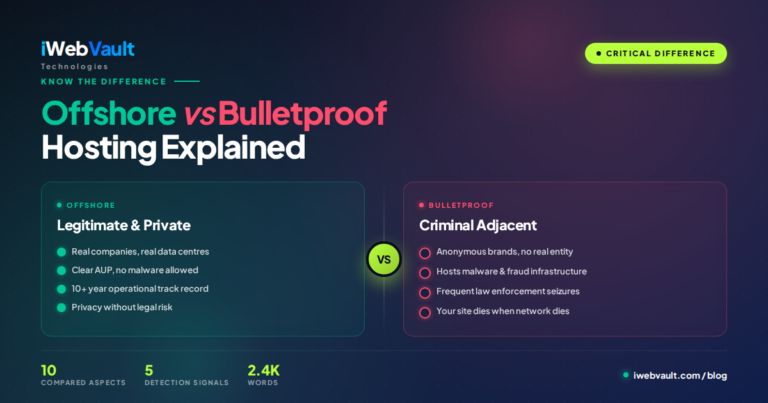
Legitimate exchanges, wallets, DeFi protocols, NFT marketplaces, crypto education, blockchain explorers, mining pool dashboards, privacy coin projects, and Bitcoin-only services are all welcome. The line is between privacy and impunity, same as we covered in our offshore vs bulletproof post.
Frequently Asked Questions
Yes, with the right plan. Small exchanges and exchange front-ends can run on our higher-tier VPS plans; larger operational exchanges should use our dedicated server tier for the resource isolation and performance. Custodial exchanges need additional security hardening that goes beyond hosting setup — see your team’s security architect for that.
Yes. Privacy coins are legitimate cryptocurrencies with active research communities. Front-ends, mining pool dashboards, block explorers, and educational sites for Monero or Zcash are all welcome at iWebVault. The fact that some governments dislike privacy coins doesn’t change our jurisdiction-based AUP.
Allowed if legitimate. A meme coin with active development, a clear roadmap, and transparent tokenomics is welcome. A “meme coin” that’s actually a rugpull-in-waiting (anonymous team, no audit, designed for price pump) is banned under our anti-fraud clause. We use judgment, not category bans.
Most crypto projects start on VPS. Use shared hosting only for low-traffic content sites (educational blogs, news aggregators). Move to dedicated when you’re handling significant trading volume, custody, or sustained high traffic. Our VPS starts at $25/month, our dedicated servers from $80/month.
That depends on your jurisdiction and business model — it’s a legal question, not a hosting question. iWebVault doesn’t impose KYC on our customers, but if your project operates in jurisdictions that require it (regulated exchanges in EU, US, etc.), you’ll need to implement KYC at your application layer. Tools like Sumsub, Jumio, or Veriff handle this; configure them yourself based on your legal counsel’s guidance.
Probably, eventually. Crypto sites are common targets because they attract motivated attackers — competitors, scammers who got banned, traders who lost money, opportunistic bot operators. DDoS protection is not optional. Our VPS plans include CSF + LiteSpeed-level mitigation by default; for higher-risk projects, our dedicated servers add Imunify360 and infrastructure-level DDoS scrubbing.
Yes on dedicated server plans. Full Bitcoin and Ethereum nodes have substantial storage and bandwidth requirements that don’t fit shared or smaller VPS plans. A pruned node can run on a higher-tier VPS, but a full archive node really needs dedicated hardware. We can advise on sizing if you open a pre-sales ticket.
We respond per the same process as any other request — covered in our DMCA process post. We share only what we have, which (by design) is very little. We don’t unmask anonymous customers, we don’t suspend accounts based on inquiry letters, and we don’t take action absent a binding order from a court in our operating jurisdiction. The jurisdictional distance is real protection — that’s why it matters.
Hosting built for crypto projects that need to stay online
iWebVault’s AUP explicitly allows cryptocurrency-related services. We accept Bitcoin, Monero, Litecoin, and Ethereum at signup. Our VPS and dedicated server plans include the burst capacity, WebSocket support, and DDoS protection that crypto sites need. And we don’t fold to regulatory letters — we operate from privacy-respecting offshore jurisdictions specifically so you can keep running.