Two terms get used as if they mean the same thing: offshore hosting and bulletproof hosting. They don’t. The confusion costs people in two directions — legitimate users who pick a bulletproof host thinking they’re just getting privacy end up on infrastructure that gets seized; aspiring privacy-respecting providers get tarred with criminal associations they have nothing to do with.
The distinction matters legally, technically, and practically. An offshore host operates a legitimate business in a privacy-respecting jurisdiction. A bulletproof host operates in a regulatory blind spot specifically to harbour content other hosts won’t touch — and in 2026, that increasingly means malware distribution, phishing infrastructure, and the kinds of activities that bring down hammer-blow law enforcement raids on entire networks.
This guide draws the line clearly. We’ll cover what each term actually means, where they overlap and where they diverge, why bulletproof hosting is a trap for any legitimate use case, and how to spot the difference before you wire money to the wrong provider.
Offshore hosting is for people who want privacy and jurisdictional protection while running legitimate sites. Bulletproof hosting is for people who specifically want to host content that’s illegal nearly everywhere. Both exist — but only one is a real business model that survives. iWebVault is offshore. We’re not bulletproof, and you shouldn’t want us to be.
The Two Terms — They Are Not the Same Thing
Both terms emerged from the same underlying observation: different countries have different content laws, and where you put a server changes what content can survive on it. From there, the two categories diverged dramatically.
What offshore hosting actually is
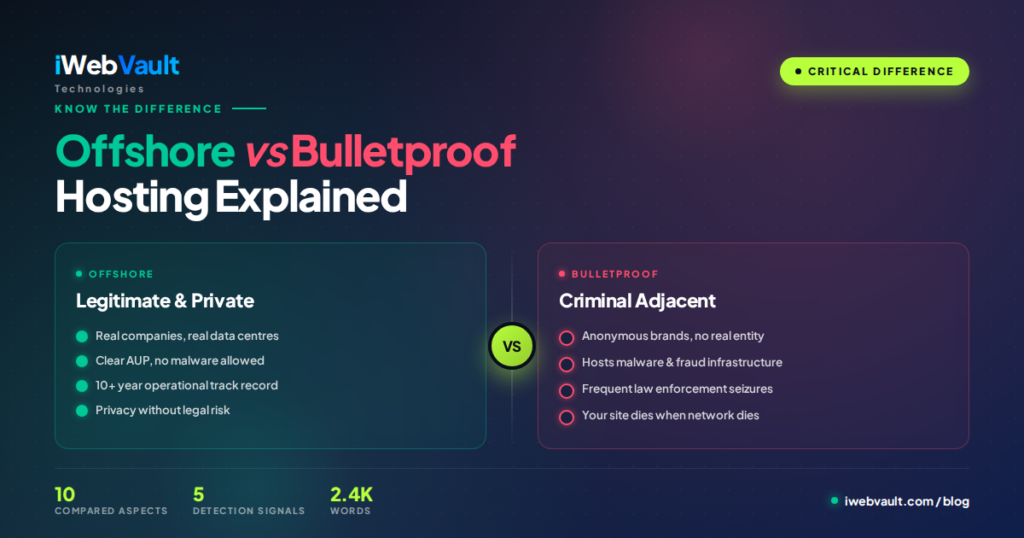
Offshore hosting is web hosting from a legitimate company operating in a jurisdiction with privacy-respecting laws — typically the Netherlands, Bulgaria, Iceland, Switzerland, or Romania in Europe; Malaysia, Singapore, or Hong Kong in Asia. The provider runs servers in real data centres, has a registered business entity, pays taxes, employs staff, and operates under an Acceptable Use Policy that explicitly prohibits genuinely harmful content (CSAM, fraud, terrorism, malware distribution).
The “offshore” part refers to operating outside US legal jurisdiction so that DMCA takedown notices have no automatic force. It doesn’t mean “outside all law” — Dutch hosting is fully subject to Dutch law, just not US law. That’s the whole point.
What bulletproof hosting actually means
Bulletproof hosting is a term that originated in cybercrime communities to describe providers who deliberately ignore all abuse complaints regardless of severity. The defining characteristic is not jurisdiction — it’s the operational stance of refusing to act on takedowns even for content that’s clearly criminal in nearly every country.
In practice, bulletproof hosts host the infrastructure that runs phishing kits, banking trojans, ransomware control servers, child exploitation material, and large-scale fraud operations. They typically operate from secrecy jurisdictions (some Caribbean micro-states, parts of the former Soviet Union, certain Pacific island nations) and are frequently run by people who themselves participate in the criminal ecosystems they serve.
Why people confuse them
Both reject US DMCA takedowns. Both market themselves with similar privacy-focused language. Both accept cryptocurrency. From a casual Google search, they look identical. The difference shows up only when you read the Acceptable Use Policy carefully, examine the legal entity behind the company, and look at the operational record over multiple years.
Side-by-Side Comparison
| Aspect | Offshore Hosting | Bulletproof Hosting |
|---|---|---|
| Legal status | Legitimate business operating under local law | Often operating in legal grey areas or actively criminal |
| Typical jurisdiction | Netherlands, Bulgaria, Iceland, Switzerland, Malaysia | Caribbean micro-states, ex-Soviet states, Pacific tax havens |
| AUP enforcement | Bans CSAM, fraud, malware, terrorism — enforced | Often no real AUP enforcement on anything |
| DMCA stance | Notices have no legal force; forwarded to customer | All notices ignored regardless of severity |
| Infrastructure | Tier-3+ data centres, real hardware, redundancy | Often single small data centre, frequent moves |
| Support | 24/7 professional ticket system | Sporadic, sometimes only via encrypted messaging |
| Payment | Crypto + traditional methods, transparent | Crypto only, often through intermediaries |
| Risk to user | Low — legitimate service with clear terms | High — frequent seizures, reputation by association |
| Typical customers | Journalists, privacy advocates, adult sites, forums | Phishing operators, malware distributors, fraud rings |
| Average lifespan | 10+ years for established providers | 12-36 months before seizure or shutdown |
Why Bulletproof Hosting Is a Trap for Legitimate Users
You might think “I just want maximum privacy — surely bulletproof is more private than offshore?” That intuition is wrong, and here’s why:
1. Your site goes down when the network gets seized
Bulletproof networks attract criminal customers, which attract law enforcement attention, which results in coordinated multi-jurisdictional takedowns. Brian Krebs has documented dozens of these over the past decade. When the provider goes down, every customer goes down with it — including the legitimate ones. Your “private” site is suddenly offline, your data is in the hands of investigators, and you have no recourse.
2. Some are honeypots run by law enforcement
Several “bulletproof” providers in recent years have been seized control of by Europol, the FBI, or national agencies and run as honeypots to identify users. Customers continued paying and uploading data for months before discovering their entire activity was being logged for prosecution. Operation Trojan Shield, the takedown of Anom, and similar operations have made this a standard investigative tactic.
3. Reputation damage by association
Hosting your site in the same IP range as ransomware C2 servers gets your site blacklisted by Spamhaus, by Google Safe Browsing, by major email providers, and by every commercial threat-intelligence feed. Even if your site is perfectly legitimate, visitors get warned that it’s dangerous. Search engines de-rank you. Your email goes to spam everywhere.
4. No service-level agreement, no real support
A legitimate offshore host promises a certain uptime, has a backup strategy, and answers tickets professionally. A bulletproof host promises nothing and answers only when they feel like it. When something breaks, you have no recourse — they don’t even know who you are and they don’t care.
5. Payment instability
Bulletproof hosts get cut off from payment processors regularly. Their crypto wallets get blacklisted. They change company names and ask customers to migrate. Your “permanent” hosting account is anything but permanent.
6. Frequent infrastructure changes
To stay ahead of takedowns, bulletproof networks move servers between data centres, between jurisdictions, between business entities. Your site goes down for 48 hours while they migrate, your DNS changes, your data may be lost in the move. None of this happens at a legitimate offshore host.
Why Offshore Hosting Is the Right Choice for Privacy
Everything bulletproof hosting fails at, legitimate offshore hosting handles properly. The privacy benefits are the same — jurisdictional protection from US DMCA, anonymous signup, crypto payment, no real-name attestation. The difference is that offshore hosts achieve those benefits while still running as legitimate businesses.
Real infrastructure, real uptime
iWebVault runs hardware in tier-3 Amsterdam and Sofia data centres with redundant power, multi-homed networking, and 99.9%+ uptime. Same as any premium hosting company — we just happen to operate outside US legal reach.
Clear, written acceptable use policies
Our AUP is published, specific, and enforced. CSAM is banned and reported. Direct incitement to violence is banned and reported. Malware distribution is banned. Phishing kits are banned. Fraud operations are banned. Everything else is between you and the law of the country you operate in. That’s the difference between privacy and impunity.
Predictable longevity
Top offshore providers have been operating continuously for 10+ years. Shinjiru is past 20. AbeloHost and Orange Website are past a decade. iWebVault is younger at three years, but our infrastructure is built on the same legitimate foundation. None of us are going anywhere unless we choose to.
Professional support, not “shoutbox” support
Real ticket systems, real escalation paths, real engineers. When your site has an issue at 3 a.m., a human reads the ticket, diagnoses the problem, and fixes it — usually within an hour. Compare that to bulletproof “support” that may not respond for days, if ever.
Stable payment, transparent billing
We take Bitcoin, Monero, Litecoin, Ethereum, and traditional methods. Bills are dated, totalled, and itemised. Your account doesn’t suddenly disappear because a payment processor cut us off.
The Acceptable Use Policy Difference
The clearest single signal of whether a host is offshore or bulletproof is the Acceptable Use Policy. Read it carefully before you commit.
What every legitimate host bans (offshore included)
- Child sexual abuse material (CSAM). Universally criminal, universally banned, universally reported to authorities.
- Direct incitement to violence or terrorism. Banned by US, EU, and most major jurisdictions.
- Active fraud operations. Phishing pages, fake banking sites, advance-fee scam infrastructure.
- Malware distribution. C2 servers, exploit kits, ransomware payloads.
- Spam infrastructure. Open mail relays, mass-mailing operations targeting protected lists.
What offshore hosts allow that mainstream US hosts don’t
- Adult content (where legal in the host’s jurisdiction)
- Journalism and political content under DMCA pressure
- Streaming aggregators and indexers
- Forums on controversial topics
- Whistleblowing platforms
- File hosting and archive services
- Cryptocurrency-related services
What bulletproof hosts allow that offshore hosts don’t
- Phishing pages and credential harvesting
- Malware command-and-control infrastructure
- Active fraud operations
- Spam and bot networks
- In some cases, child exploitation material
If a host’s AUP is missing, very short, or essentially says “anything goes,” that’s a bulletproof signal. A real offshore host will have a clearly written, multi-section AUP with specific prohibited categories. We’re proud of having a detailed one.
How to Tell the Two Apart Before You Pay
A few simple checks separate legitimate offshore hosts from bulletproof operators:
1. Find the legal entity
A legitimate offshore host has a registered company in its operating jurisdiction. The company name appears in the footer or terms of service. You can verify the registration through public business registries. Bulletproof hosts typically have no findable legal entity — just an anonymous brand name and a Bitcoin address.
2. Check the data centre relationships
Legitimate hosts publish where their servers live. We mention specific data centres in Amsterdam and Sofia. Bulletproof hosts say “secret undisclosed location” or hint at “unidentified” infrastructure. Real infrastructure has a real address.
3. Read the AUP carefully
Use the criteria above. If the AUP doesn’t ban CSAM, malware, and active fraud explicitly, that’s a bulletproof signal regardless of how the marketing reads.
4. Look at the operational history
Established offshore hosts have years of customer reviews on independent forums (LowEndTalk, WebHostingTalk, HostingFactor). Bulletproof hosts often have no findable customer reviews because customers are reluctant to identify themselves publicly.
5. Check for staff and contact information
Real companies have findable staff on LinkedIn, founders who have spoken at conferences, customer support agents with names. Bulletproof hosts are anonymous from the inside as well — no findable humans behind the brand.
Frequently Asked Questions
Operating a hosting business is legal everywhere. What makes bulletproof hosting legally precarious is the deliberate facilitation of illegal customer activity. In most jurisdictions, knowingly hosting criminal infrastructure makes the host a participant in that crime — which is exactly why bulletproof networks get seized in coordinated international operations.
We’re offshore. We operate registered companies in legitimate jurisdictions, run real infrastructure in tier-3 data centres, publish a detailed AUP that bans CSAM, fraud, and malware, and respond appropriately when our AUP is violated. We protect customer privacy and reject US DMCA takedowns — that’s the offshore stance — but we don’t host the kind of content that gets networks seized.
In theory, yes — but only if you violate the local law of the jurisdiction where the server is hosted. Dutch courts can compel removal of content that violates Dutch law. Bulgarian courts can compel removal of content that violates Bulgarian law. These standards are far more permissive than US law, but they’re not infinite. Stay within the AUP and the local law and you’re protected.
Because their business model depends on hosting content that’s illegal in every reasonable jurisdiction. CSAM, active fraud, and malware are criminal everywhere — there’s no country where running infrastructure for those activities is legal. The only way to host them is in regulatory blind spots that eventually get closed.
Because choosing the wrong category exposes you to risks that defeat your privacy goal. A bulletproof host that gets seized hands all your data to investigators. Reputation damage from sharing infrastructure with criminals affects your site’s reach. The seemingly more “private” option turns out to be the less reliable, more risky one. Legitimate offshore hosting is what privacy-respecting users actually want.
No. Plenty of legitimate hosts operate from Romania, Bulgaria, the Baltic states, and other Eastern European jurisdictions. The label depends on operational behaviour, not geography. A Bulgarian host with a clear AUP, registered company, and professional operations is offshore. A Bulgarian host with no AUP, no findable legal entity, and a Bitcoin-only payment flow is bulletproof.
On reputable offshore hosts, no — the AUP filters out the truly bad actors before they can establish themselves. iWebVault enforces our AUP actively, including IP reputation monitoring. We get listed as clean by Spamhaus, Google Safe Browsing, and the major threat-intelligence feeds. Your site’s reputation rises or falls based on your own content, not your neighbours.
Migrate as soon as possible. Take a full backup of your site to off-server storage, sign up with a reputable offshore host, restore the site, update DNS, and let the bulletproof host expire. We have a step-by-step migration guide in our WordPress hosting setup post that applies to non-WordPress sites as well.
Real privacy on legitimate infrastructure
iWebVault is offshore hosting done right — privacy-respecting, jurisdiction-aware, but built on legitimate infrastructure with a clear AUP that protects you from the risks of sharing space with criminal operations. Get the privacy benefits without the seizure risk.